
Beautiful Model Trees For Your Miniature
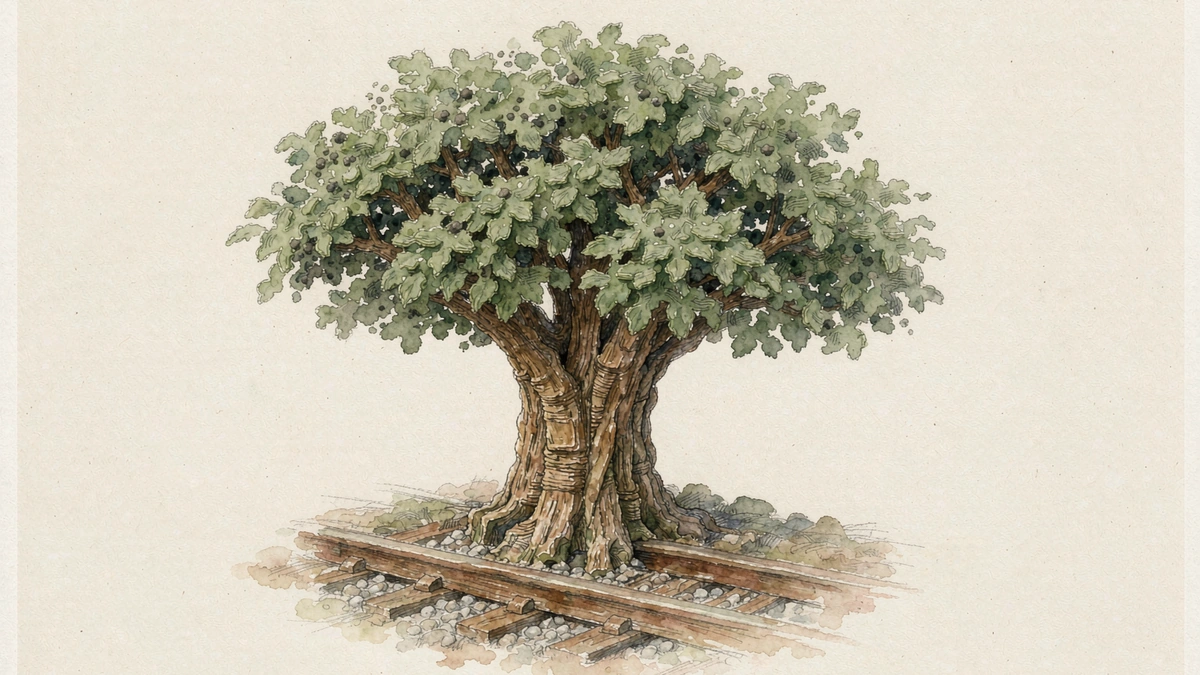
There is a moment on most O scale layouts when the builder realises trees are going to be a problem. It usually arrives when a finished tree is held next to a locomotive and turns out to be roughly the size of the locomotive.
O runs at 1:48. A tree in O is not a scaled-up version of an HO tree — it is a different object, built to different tolerances, with details nobody notices at 1:87 suddenly fully visible from across a room. We build both scales on the same Shenzhen floor, and O is where our makers spend the most time per piece. Twenty years at this has taught us exactly where the problems sit.
Here is what changes at 1:48, and what we do about it.
HO is 1:87. O is 1:48. Divide one by the other and an O tree needs to be roughly 1.8 times the height of the same tree in HO.
In practice our O canopies run 14–30 cm, where our HO ones run 8–18 cm. Translate those numbers back into real height and the O range covers trees from about 6.7 metres to about 14.4 metres. That is most of what actually grows beside a railway.
Builders coming up from HO underestimate this almost every time. They order 20 cm because 20 cm sounds enormous next to an HO photograph, then discover that 20 cm is only a 9.6 metre tree — mature garden height, not forest height. A genuinely large O gauge model trees order means asking for 30 cm, and even that represents a little over 14 metres.
Same three dimensions as HO, all of them larger, and then two extra requirements that HO does not have:
Scaled up, that 5–12 mm trunk represents a real trunk somewhere between 24 and 58 cm through. There is room in those seven millimetres to say a great deal about how old the tree is and what it has been through, which is why we treat O trunks as a modelling job rather than a casting job.
The base disc grows for a practical reason. A 30 cm tree has real leverage at the top, and an 8 mm disc — perfectly adequate in HO — will let it rock. The 15–25 mm disc keeps the tree standing, gives enough contact area for adhesive, and takes a long pin or a small screw without splitting.
HO bark gets a light pass. O bark gets roughly twice the relief, because at this scale the trunk is 5–12 mm across and every stroke is visible from arm’s length. One flat colour laid over a trunk that size reads as a plastic rod, and no amount of good foliage above it will recover the illusion.
On the hand-twisted wire trunk, our makers build O bark up in successive layers sprayed on by hand, working deeper into the shadow side and letting each pass dry before the next. The result has enough depth that a dry-brush of a lighter value catches on the raised ridges, which is what most O modellers do as soon as the tree is out of the box. It also means that viewed from two metres away — a normal viewing distance on a garden railway — trunk shading is doing more work than the leaves.
An HO canopy can be a single mass of foliage. An O canopy cannot.
At 30 cm there is simply too much foliage in one place for the eye to accept as one lump. Our O canopies are built in layers with real branch structure between them, so light passes through the tree and, in places, so does sight. Those gaps are deliberate. A tree you can partly see through reads as older, larger and further away than one you cannot.
This is the part of an O tree that takes longest per piece, and it is why we quote O separately rather than applying a multiplier to an HO price. A 30 cm layered tree involves several times the bench time of a 16 cm one.
We build any species to order — from a photograph or a client’s reference — across two trunk materials, hand-twisted wire armature and die-cast plastic. In O, four codes cover most of what leaves our workshop.
FO-001 — Deciduous broadleaf, 14–25 cm. The workhorse. Station approaches, gardens, village greens, anything where the tree has to belong near buildings without swallowing them. The spread of sizes inside the code is wide enough that you can build a believable street from this one species alone.
FO-008 — Conifer, 18–30 cm. The tall one. Screening, woodland blocks, cuttings, and anywhere you need vertical mass. It is also the tree to use when a layout boundary has to disappear — a row of these at the back edge does more to hide a fiddle yard entrance than any amount of scenery painting.
FO-014 — Metal armature trunk, bendable. A different construction: the trunk carries a metal core you can shape, so you can set the lean, push the crown off-centre, or open one side as though the tree has spent forty years growing away from the wind. This is the hero tree for a garden railway, the one put where visitors will stop and look.
FO-040 — Hand-painted premium. Every colourway we mix, one piece each, so no two in a batch match. At O scale each of these carries enough visible detail to justify a focal position: a single tree beside a water tower or level crossing can carry an entire scene.
An indoor O layout needs a tree that looks right. A garden railway needs one that still looks right after a summer outdoors.
For outdoor installations we can finish trees with a UV-resistant clear coat. It does two jobs: it slows the fading of foliage pigment under direct sun, and it puts a protective film over the sprayed bark on our wire-trunked trees so rain does not work into the paint layers.
We will be straight about the limits. No clear coat makes an outdoor layout permanent — pigments fade eventually, and anything living outdoors for years will show it. What this finish does is slow the fade enough that a single season does not visibly reorder your planting scheme, or leave you with one shaded corner going a different colour from the rest. Bringing the most prominent pieces under cover over winter lengthens that considerably.
If you are specifying a garden railway, tell us at quotation stage. The clear coat is applied before packing, not afterwards.
Our standard ceiling is 30 cm, which is a shade over 14 metres at 1:48. That already reads as a very large tree on almost any layout.
Custom work takes us to 45 cm, roughly 21.6 metres full size. That is conifer or sequoia territory, meant for garden railways and large outdoor scenes rather than an indoor shelf. Garden sequoias can be built to your own target height and trunk diameter if you tell us what you need — we quote feasibility and freight together, because above this size the two questions stop being separate.
The packing that protects an HO tree does nothing for an O tree. More canopy, more leverage, and the trunk becomes the thing that snaps.
Each O tree is individually foam-wrapped, then boxed in oversized cartons sized around the tallest tree in the run, with foam lining on every face so nothing shifts and nothing is compressed. From roughly 200 pieces upward we build a wooden crate instead, which survives being stacked and strapped on a pallet in a way no carton does.
If anything does arrive damaged, photograph the crate and the tree and send both to us. We hold the production record for every order, so a replacement is built to the original specification rather than guessed at.
Our minimum is 50 pieces in O as well, and it is still 50 across the order rather than 50 identical trees. That is uncommon at this scale, where suppliers frequently want a hundred or more of a single code before they will tool anything.
A typical mixed O order might put 20 pieces into FO-001, 15 into FO-008, 10 into FO-014 and 5 into FO-040. That gives you the everyday street trees, the screening height, the posable feature pieces and a proper focal point for the place where visitors stop — in one production run, against one lead time.
Lead time runs from sample approval and is 15 working days thereafter. Every tree is checked at three points before it ships: after the trunk is finished, after the canopy is layered, and again at packing. The last of those matters most in O, because it is the stage where the packing method meets the most fragile tree we make.
We are the factory rather than a trading company, shipping direct from our own Shenzhen floor since 2003. There is no middleman margin sitting between your invoice and the bench the trees were built on.
We do not pre-weather O trees either, and at this scale the reasoning gets stronger. An O tree has far more visible surface than an HO one, so any weathering we guess at is guesswork across a much larger area — and the wrong wash on a 30 cm tree is a problem you can see from the other end of the room.
Trees arrive in clean, neutral tones with the bark and foliage left open to whatever you need: dust for a freight setting, lichen for coastal branch lines, autumn values for seasonal displays. Do it after the trees are planted and you can judge it against the whole scene rather than against a bench.
The same soil dust, rust wash and leaf-tone consistency work applies to model railway layouts indoors and out — the difference outdoors is simply that everything needs a protective coat over the top when you are finished.
O orders vary more than HO ones, so a vague request gets a vague answer. Five things let us quote properly the first time:
Give us those and we come back with a price and a production date rather than a list of further questions.
O scale is expensive to get wrong. Twenty minutes with real pieces in your hands answers questions that a week of emails will not: whether the bark relief reads at the distance you actually view from, how much light passes through a layered canopy, whether the trunk diameter looks right against your stock.
That is what our twelve-piece free sample pack is for — six of our most-ordered species, each in both trunk materials (die-cast plastic and hand-twisted wire armature). Check the foliage material, how it is fixed to the branch armature, and how the bark on the wire-trunked trees takes a dry-brush — all of which carry across every tree we make. Tell us on the request form that you build in O, along with the three species you most want to see, so we know what you are comparing against. The pack itself is free and you cover shipping: $9.9 for standard tracked delivery, 7–12 working days, or $39.9 by DHL, UPS or FedEx in 3–5 working days when you are working to a fixed date.
From there the specifications and current codes are on our O gauge model trees page. Look there, request the free sample pack, and hold twelve real pieces before you commit to fifty.