
Beautiful Model Trees For Your Miniature
What makes a miniature palm read as a palm - trunk taper, leaf-scar rings, frond count and crown shape - and what survives the drop to 1:87.
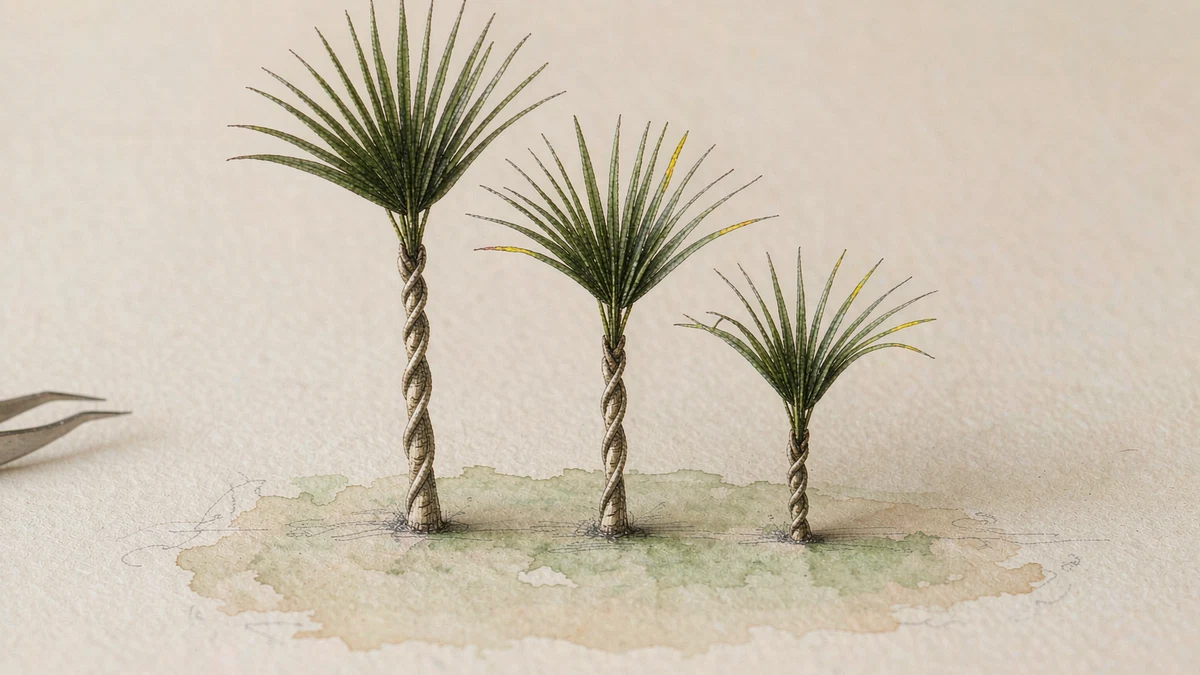
A customer sent us a photograph of a beach in Hainan last spring and asked for four hundred coconut palms in HO. Nothing wrong with the photograph. The problem was that nearly every model palm you can buy is the same object: a straight brown stick with six green feathers glued to the top. Real palms do not look like that, and the eye registers the difference before the brain names it.
Palms break three of the rules we build every other species to. Get those three right and a palm reads as a palm from across a room, at any scale. Get them wrong and you have a green lollipop. We have built them on the same Shenzhen floor since 2003, for railway layouts, architectural models and beach diorama work.
No branches. A broadleaf tree divides and divides again until the divisions are twigs, and the foliage sits on a framework you can see through in winter. A palm has one growing point: a single stem goes up, and all the foliage comes out of one place at the top.
So the trunk alone has to say how old and how weathered the tree is, with no branch structure to help it. And a palm trunk is not wood in the way an oak trunk is wood — it is a fibrous cylinder carrying a record of every leaf it has shed, as ring scars up its length. The most useful information on the model, and the most often missing.
Taper first. A coconut palm is not a cylinder — thickest just above the ground, narrowing through its length, slimmest where the crown begins. Build a parallel-sided tube and you have made a flagpole.
Then the curve. In the reference photographs clients send us, a coconut palm in the open is rarely vertical — ten to twenty degrees of lean is common, more on an exposed coast. We set that lean by hand and differently on every piece, because a row leaning alike looks like a fence somebody pushed over.
A mature coconut crown carries twenty-five to forty fronds. Most model palms carry six to ten. That is why they look wrong, and it is cheap to fix.
Nor do they radiate evenly. The newest near the centre stand up, the middle sits horizontal, the oldest hang — and a frond is a long arc, not a flat feather. Where it starts to fall gives the palm its character: flat to seventy percent and then dropping reads young, starting to fall at forty percent reads old.
A coconut frond runs three to six metres in life, so at 1:87 you get up to seven centimetres of frond on a tree standing about twenty-three centimetres tall. The crown looks too big to anyone who has only seen full-size palms; it is not. But it does have to be open — fronds leave a single point and separate as they travel out, so there should be daylight between them.
The three palms we are asked for most are genuinely different shapes.
Beyond those three we build any species to order from a photograph or your own reference. Bamboo is worth a note: it is not a trunk-and-canopy tree at all but a clump of culms with visible nodes, where node spacing and the slight taper of each culm matter more than any crown.
Finer grades of the same dyed sponge also go out as lawn and groundcover — plant palms and you want something underneath them, because a bare base disc in a finished beach scene is the loudest giveaway there is.
Scale decides what is worth attempting. A twenty-metre coconut palm is about 23 cm in HO, roughly 12.5 cm at N, and over 40 cm at O.
Inside that, the leaflets are the problem. On a real frond they sit a centimetre or two apart along the midrib; at HO that gap is a fraction of a millimetre. We do not attempt separate leaflets at 1:87 or 1:160 — we cut the frond outline and let the edge of the material do the work. What we keep is the midrib, the line that makes a frond read as a frond. At O there is room to hint at the leaflets, and we take it.
The foliage is the same dyed sponge we use on every tree, in different grades and colours. For palms we work it into thin strips rather than the crumbled clusters of a broadleaf canopy, so the frond edge stays thin enough to see light through.
Everything we make sits on one of two trunk types, and for palms the choice matters more than usual.
Hand-twisted wire armature. Our makers scale the species’ proportions and wind the trunk by hand. Nothing is moulded, so no two are alike, and the twist leaves a fine ring texture close to the leaf-scar rings on the real thing. Usually the right answer for palms — real palms are individually crooked, and identical straight ones give the game away the moment you plant three together.
Die-cast plastic. Designed, scaled, cast — every palm in the batch identical. Exactly right for a formal avenue, a hotel driveway or a symmetrical architectural scheme, and cheaper per piece. What it gives up is variation: up close, the eye counts.
Both take the same fronds and finishing. The question is whether your scene wants thirty individuals or one repeated shape.
We do not pre-weather anything. Trees leave in clean, neutral tones under a matte sealer, because a workshop in Shenzhen does not know what your ballast, grass, buildings or lighting do. A wash perfect for a grey coastal layout is wrong for a warm inland one — and we would be guessing across four hundred pieces instead of one.
The matte sealer takes acrylic, enamel and oil without preparation. For a palm the sequence that works is a dry-brush of pale grey up the trunk to bring the rings forward, dust on the lower fronds, and the detail that sells it: one or two dead brown fronds hanging under the crown. Real palms always have them.
Palms are the species where buying blind goes worst, because the difference between a good one and a bad one is almost entirely in the crown — and photographs flatten it.
Our sample pack is twelve trees: six representative shapes, each in both trunk materials, so you can put a hand-twisted wire palm next to a die-cast one of the same species. The pack is free and you cover shipping — $9.9 tracked standard in 7 to 12 working days, or $39.9 by DHL, UPS or FedEx in 3 to 5.
Minimum order is 50 pieces, mixed freely — species, trunk material and height in one run. Production is 15 working days from sample approval, not from payment. Every tree is foam-wrapped individually; we have shipped more than 100,000 pieces and breakage sits below 0.5 percent, and a palm crown is the most fragile thing we make. Specifications are on our HO, N, O and OO pages.