
Beautiful Model Trees For Your Miniature
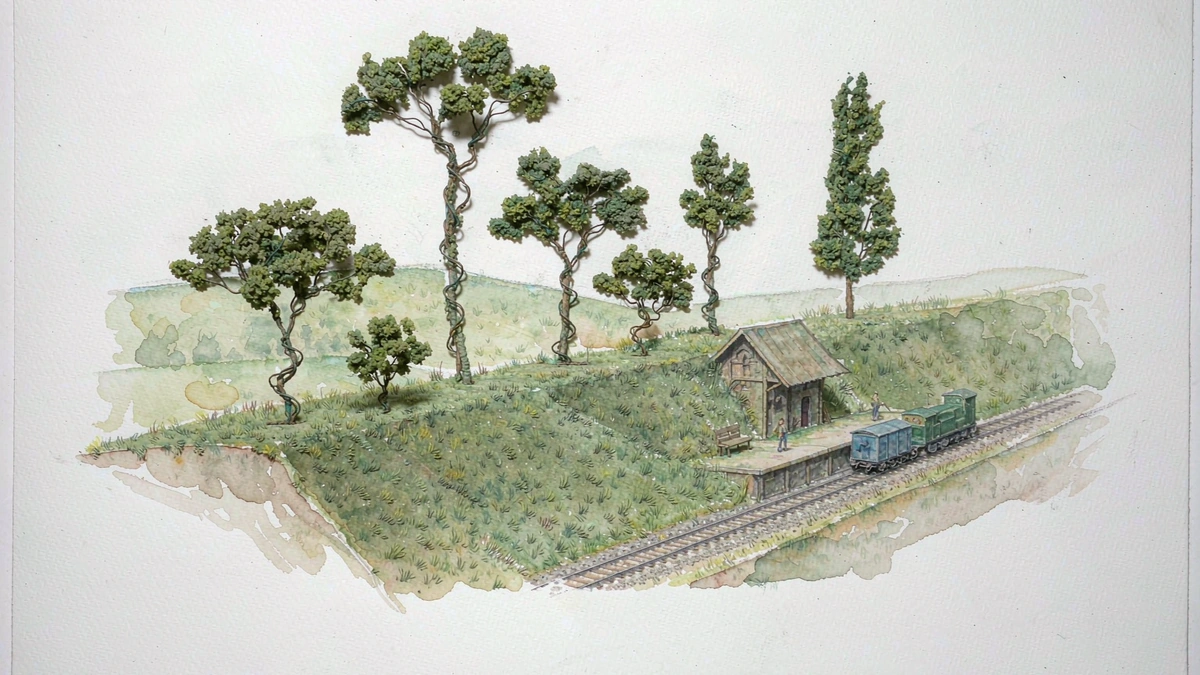
Every week we get photographs from layouts where something is wrong and the builder cannot put a finger on what. Nine times out of ten it is the trees. The colour is fine, the price was fine, and the height is wrong — so a street of mature limes reads as topiary, or a rural cutting reads like a redwood grove.
We have been making model trees in our Shenzhen workshop since 2003. HO is the scale that leaves our floor most often, and it is the scale where a centimetre of error is easiest to see and hardest to un-see. Here is what we build to, and why.
HO runs at 1:87. No other number matters as much as this one when you are choosing trees.
Divide real height by 87 and the sizes get small very quickly:
Those are the numbers behind our 8–18 cm canopy range. We did not pick it because it looks tidy on a spec sheet. It is what 1:87 does to the trees that actually grow beside houses, fences and railway embankments.
Drop below that band and you have planted a shrub. A 5 cm tree at 1:87 represents roughly 4.3 metres — a good hedge, a poor avenue. Push above it and every scene turns into California. Most of the ready-made packs sold as HO gauge model trees cluster at the bottom of the range, because short trees use less material and pack into smaller boxes. That is usually where the “why does my layout look like a bush” problem starts.
Every HO tree we make is quoted against three dimensions. They are worth learning, because once you know them you can specify a whole order in one email without sending a drawing.
The trunk figures look too small to matter until you scale them up. A 2.5 mm trunk represents a real trunk of about 22 cm in diameter. A 6 mm trunk represents roughly 52 cm. That is the whole difference between a sapling somebody staked last spring and a tree that has stood since the station was built, and it only takes three and a half millimetres of plastic to say which one you mean.
The base disc matters more than people expect. At 8–14 mm it is small enough to disappear under scatter and ground foam, and solid enough that you can drill through it and pin the tree rather than glue it. Pinning is worth doing on any layout that travels to exhibitions: a pinned tree can be lifted out, packed separately, and dropped back into the same hole at the other end.
We make HO trunks two ways, and the choice comes down to whether your scene needs fifty trees to hold a line or one tree to carry a moment.
Die-cast plastic trunk is our default for grouped planting — the streets, residential blocks and urban scenes where a tree’s job is to belong to a row rather than to stand out. It holds dead vertical, which is what gives a street of fifty trees its consistency, and it is cast from plastic that already carries its colour — usually a deep or dark green — so bark texture and tone are identical across all fifty. That uniformity is the reason to choose it. The hand-twisted wire trunk is the other option: the shape is wound by hand to the species, and its bark is built up with paint sprayed on by hand, one tree at a time, so no two come out identical.
Wire armature trunk is the flexible option. The trunk carries a bendable metal core, so you can push a branch aside, set a lean, or freeze the tree mid-action — the kind of dynamic pose you want when a vehicle is passing through a 1:87 scene and the tree should read as caught in motion rather than planted in a grid. It is the tree you reach for when a single piece has to do expressive work in a close-up or a focal spot.
The two types are not interchangeable in a scene. Wire armature is wasted in a back row, where nobody reads the pose, and hard plastic is too rigid for the foreground tree you want to characterise. Most orders mix them: hard plastic for the streets and the masses, a few wire armature pieces for the corners, the station front and anywhere the eye lingers.
Both types take the same matte canopy finish, so mixing the two in one scene does not break the illusion — the difference sits in the trunk. A die-cast trunk repeats exactly, tree after tree. A hand-twisted wire trunk carries bark sprayed by hand, which is why fifty of them in one order are fifty slightly different trees.
Every canopy leaves our workshop with a matte seal over the foliage.
Matte is the neutral choice. Gloss catches layout lighting and throws a highlight off every leaf cluster, which photographs badly and looks worse in person. Matte reads as foliage at every distance you are likely to view it from.
The seal is also a working surface. Our canopies take acrylic, enamel and oil paint without separating or going tacky. You can dry-brush a lighter value onto the upper shoots, work a wash into the shadow side, or push an entire batch warmer or cooler so it sits correctly against your ballast and ground colour. Scenic teams weathering fifty or a hundred trees need that predictability — an unsealed foliage surface absorbs paint unevenly and the batch stops matching about two thirds of the way through.
Height gets all the attention. Density does most of the damage.
When every tree on a layout is the same height and the same density, the row stops reading as trees and starts reading as a flat green wall — the visual equivalent of a painted backdrop. It happens on architectural site plans and it happens on model railway layouts, and it is fixable before you buy anything.
Three rules we give customers:
We build any species to order — from a photograph or a client’s reference — across two trunk materials, hand-twisted wire armature and die-cast plastic. Four codes account for the bulk of our HO orders.
FO-001 — Deciduous broadleaf, 8–14 cm. Our default town tree. If you are building terraced housing, a high street, or anything urban and you do not want to think hard about species, this is the one. The mid-range height means it never dominates a building it is supposed to be softening.
FO-008 — Conifer pine, 10–18 cm. Mountain, rural countryside, forestry and logging scenes. It is also the tree we recommend when a layout needs height somewhere that would look wrong with a broadleaf: cuttings, embankments, the treeline behind a station.
FO-031 — High-canopy forest tree, 8–14 cm. Street rows and park edges. The crown sits high on the trunk, which leaves usable space underneath for figures, benches, stock and trackside detail. This is the code to specify when the trees have to share space with something.
FO-040 — Hand-painted premium. Every colourway we mix, so no two pieces in a batch are identical. Used sparingly, as the focal tree in a scene: the one in front of the signal box, the one in the village square. Ordering fifty of them defeats the point.
Architectural and planning clients rarely want a generic tree. They want the plane trees on a particular boulevard, or the specific mix of birch and spruce on a site that is about to be redeveloped.
Send us photographs and we work from them. What we match is species, canopy density and colour tone. Four shots are usually enough: one full view of the tree, one close shot of the bark, one of the ground at the base, and ideally one taken with a person or a vehicle in frame so we can size the tree from a known reference. If something in your photographs falls outside what we can build at 1:87, we tell you at quotation stage rather than quietly substituting something close enough.
Our minimum order quantity is 50 pieces — and that is 50 across an order, not 50 of one code. As far as we know it is the lowest minimum in the industry for custom trunk shape and custom species.
Because codes can be mixed, one MOQ 50 covers most small layouts comfortably. The split most customers start with is 20 broadleaf, 20 conifer, 10 of something specific, which handles a town edge meeting open countryside without leaving you forty duplicates you cannot place.
Lead time runs from sample approval, not from the day you pay. Once a sample is signed off we need 15 working days for the production run. Every tree passes three inspection points before it is boxed — after the trunk is painted, after the canopy is assembled, and again at final packing. Anything failing those checks goes back to the bench rather than into the carton.
We are the factory, not a trading company, and we have worked from the same Shenzhen floor since 2003. There is no middleman margin between our bench and your invoice.
A finished tree is mostly air by volume. Pack it badly and it arrives as a bag of loose foliage and a bent trunk.
Every tree we ship is individually wrapped in foam before it goes into the carton, so nothing rattles against anything else in transit. Over twenty years we have sent out upwards of 100,000 HO trees this way, and our damage rate sits below 0.5 per cent.
When damage does happen — carriers have bad weeks — photograph the carton and the tree, send both to us, and we replace it. We keep the production record for every order, so a replacement is built to the original specification rather than approximated from a description.
Our trees ship in clean, neutral tones. We do not pre-weather them, and that is deliberate.
Every layout carries its own palette. A factory-applied wash that looks right under bright Mediterranean light turns muddy under Northern European light, and dust that suits a working freight yard looks like neglect in a residential street. Weathering should be the last thing that happens, after the tree is planted and you can see it against everything around it — not something we guess at in a workshop in Shenzhen.
What we do instead is leave the surface ready for it. The matte seal accepts washes, filters and dry-brushing without fighting the paint, so your team can take fifty trees to one consistent standard in a single session.
You should not have to take any of the above on faith.
Our twelve-piece free sample pack puts our material in your hands: six of our most-ordered species, each in both trunk types — hard plastic and wire armature. Check the bark under your own layout lighting. Cut a canopy open to see how the foliage is fixed to the armature. Hold the trees next to rolling stock you already own and see whether the height is right, because that is the question our email cannot answer for you.
The pack itself is free and you cover shipping: $9.9 for standard tracked delivery, 7–12 working days, or $39.9 if you are working to a deadline, which goes by DHL, UPS or FedEx in 3–5 working days.
If you are specifying trees for a client presentation or a batch of layouts, treat the pack as your reference set. Mark it up, send it back with notes, and we build the production run to it.
If you are planning scenery now, start with our HO gauge model trees page for the current specifications and species codes, then request the free sample pack and hold twelve real pieces before you commit to fifty.