
Beautiful Model Trees For Your Miniature
A working comparison of Christmas tree model materials - trunks, foliage, flocking and the scale traps that give a festive scene away.
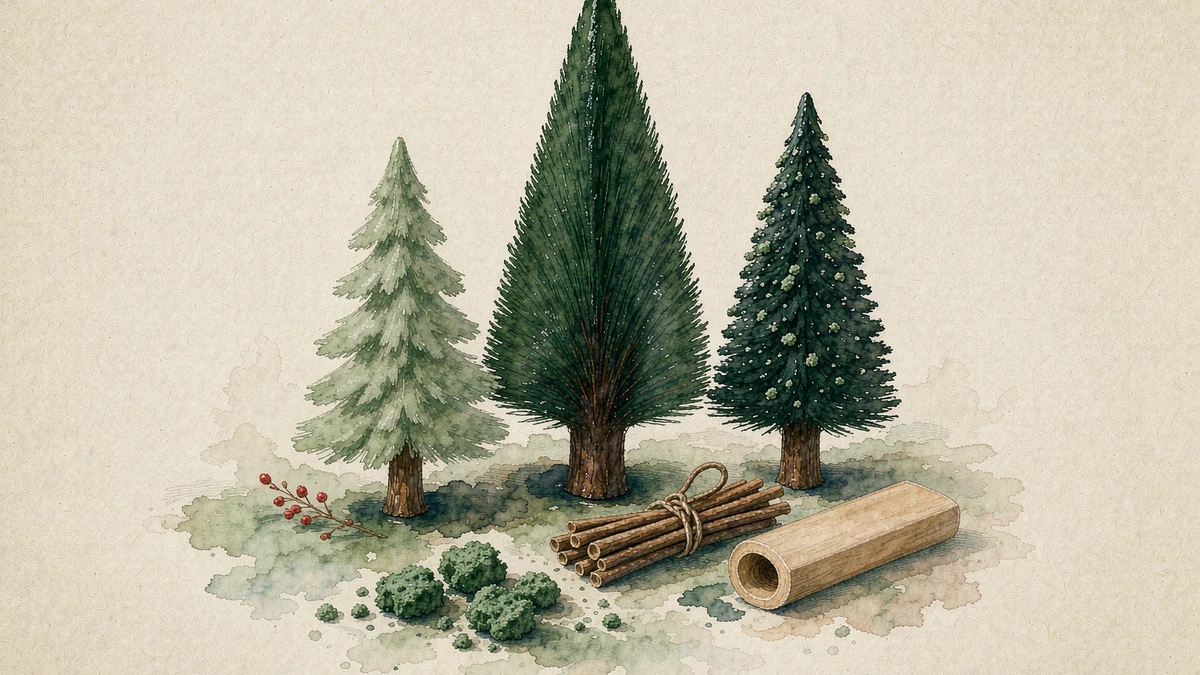
Every October the same request lands in our inbox: a Christmas tree for a layout, a shop window or a winter scene, and it has to look right at a scale where nothing is forgiving. We have been building model trees in the same Shenzhen workshop since 2003, and the honest answer is never “one material”. It is a combination, and which one depends on your scale.
A realistic Christmas tree model comes down to six decisions: trunk material, what stands in for needles, how the snow goes on, the paint and sealer that finish it, the decorations, and what it stands on. Get four right and two wrong and it still looks like a toy.
Take a Norway spruce of about 15 metres. At 1:87 (HO) that is roughly 17 centimetres tall; at 1:48 (O), around 31; at 1:160 (N), barely nine. The real needles are 15 to 20 millimetres long, so at HO they should be about 0.2 millimetres — finer than a human hair. Nobody makes a needle that fine and fixes it on by the thousand.
What your eye reads at that size is not needles. It is silhouette, mass, and the value of the green — dark where the crown is dense, lighter where the top catches the light. At 1:48 you have far more room: branch structure becomes visible, and a foliage that looked like a bottle brush at HO can be entirely convincing at O. That is why we ask about scale before we ask about species, and why we build separately for railway models, where viewing distance is fixed.
We keep this simple: two trunk materials, and nothing else.
Hand-twisted wire. We miniaturise the shape of the real species, then a maker twists the wire by hand, a little at a time — trunk, main limbs, then the fine ends — building the taper from the root flare up to the tip. No two come off the bench identical, which is the point when the tree stands within arm’s reach.
Die-cast plastic. The shape is designed, tooled and cast. It carries sharp, accurate detail, it is considerably cheaper, and every trunk in the batch is identical — a virtue when you are planting a row of forty along a cutting, a weakness when the tree is a single centrepiece. It is cast in pre-mixed colour — usually deep green or dark green — so nothing is sprayed onto this trunk by hand; a hand-twisted wire trunk is the one whose bark gets sprayed on by hand. Both accept a dry-brush if you want to push the shading further, and neither is more fragile in transit.
Almost every Christmas tree on the market uses one of four things for foliage, and they behave very differently.
Moulded PVC spines. Excellent under a magnifier, but at 1:87 they read as a brush — too regular, too shiny, tips catching every light in the room. At 1:48, on a conifer people will study, they work well. For broadleaf they are hopeless.
Dyed sponge. What we use. It comes in different thicknesses and colours, and its soft edge is what lets it read as a mass of foliage rather than a collection of objects. The fine grades do double duty as grass and ground cover.
Sea foam and lichen. Beautiful for a broadleaf clump, and we are asked for them often. They are not what we build with, for three reasons: they shed, every batch arrives a different colour, and as natural products they cannot be held consistent across a run of several hundred pieces.
Static grass and flock. Fine as a texture on top of something else, bad as the crown. It ends up looking like a pipe cleaner and holds dust for the life of the layout.
This is the question we get most. Spray-painted foliage has a failure mode you discover later: the colour sits on the surface. Crush a branch while planting, cut the crown down to fit a ceiling, or let two trees rub together in a box for a week, and the pale core shows as a white scar. Under display lighting the top coat drifts warmer too.
Our sponge is dyed through, so you can cut, thin and reshape it after it arrives with nothing to touch up. That matters more here than on any other tree we make, because nearly everybody trims a Christmas tree — to fit a room, a corner, or a ceiling lower than it looked on the plan.
If you are doing the ground as well, our foliage powder and the finer sponge grades are the same materials our makers use for scrub and grass.
We are asked for snow constantly and usually talk people out of it. Flocking fails in three predictable ways.
It yellows: the adhesive ages faster than the tree, and after two or three winters under layout light the snow has gone cream. It sheds: loose fibre goes everywhere, and on a railway layout it finds the point motors first. And the scale is wrong — a one-millimetre fibre is 8.7 centimetres of snow at 1:87, so a heavy flocking job is not a dusting but a blizzard that fills in the branch detail you paid for.
Our trees leave the workshop clean and neutral, sealed matte. If you want snow, add it after the tree is planted, with an acrylic medium or a scatter whose depth you control — and use less than you think.
A real bauble is six to ten centimetres across, which is 0.7 to 1.1 millimetres at 1:87. The smallest bead in most craft shops is three or four millimetres — a beach ball hanging on a 17-centimetre tree. It is the most common thing that gives a Christmas scene away, and the easiest to fix.
What works at HO: pin-heads of matte paint, a 0.5 millimetre half-round bead, or the tip of a fine wire bent into a hook. Garlands should be thread, not cord. And an LED is three millimetres before you wire it, which at 1:87 is a football — painted highlights or fibre optics read better. At 1:48 you have room for real beads.
On a hand-twisted wire trunk, bark browns and greys are sprayed on in thin passes, not one coat: a single flat pass looks like a stick, whereas two or three thin passes let the darker colour settle into the twists of the wire and leave the ridges lighter. The grain appears on its own. Everything then gets a matte sealer, because any sheen reads as plastic under layout lighting.
We do not pre-weather. A Christmas tree in a scene is nearly always a clean, decorated tree, and how much ageing it needs depends on the light and on everything standing next to it. Acrylic, enamel and oil all sit fine on the matte coat.
Bases are the decision people forget. A 20-centimetre tree on a two-centimetre base goes over the first time somebody walks past, so we weight it or widen it. Wood and plastic both work, and a small stand suggesting a pot or tree holder sells the whole thing. Every tree is then wrapped individually in foam — we have shipped more than 100,000 pieces that way, and breakage sits below half a per cent.
Reading about materials only gets you so far. Our sample pack is six representative tree shapes, each made twice — once with a hand-twisted wire trunk, once with die-cast plastic. Twelve trees, the same shapes in both materials, side by side.
The pack is free; you cover shipping. $9.9 standard, 7 to 12 working days and tracked, or $39.9 express by DHL, UPS or FedEx, 3 to 5 working days. Photograph them with your phone; the answer is usually obvious within a minute.
Production starts at 50 pieces (shapes and species can be mixed) and runs 15 working days from sample approval. And if you are building the whole festive scene rather than a single tree, the snow, the ground cover, the figures and the shop front it stands in front of all follow the same material logic; we build trees and planting for diorama and display models on the same benches, in the same workshop.
Order your free sample pack and put the twelve trees where you can look at them properly.