
Beautiful Model Trees For Your Miniature
What actually happens on the bench: two trunk materials, bark painted in passes, layered crowns, and three inspection points before a tree is boxed.
People look at a model railway or a site plan and think they are responding to the buildings. Usually they are responding to the planting. Handmade model trees are what tell the eye how big everything else is — a door is only a door when something standing next to it is taller.
They turn up everywhere: architectural models, park and landscape schemes, urban planning layouts, railway layouts, forest scenes, and the diorama somebody is building on the kitchen table at midnight. A well-made tree gives a scene depth and scale. A poor one is the first thing you notice, and once you have noticed it, you cannot stop noticing it.
There are two things a mould cannot do. The first is variation. Forty identical trees down an embankment do not read as a wood, they read as a fence, and your eye catches the repetition before it catches anything else.
The second is judgement. Our makers look at a species, work out which three or four features make it recognisable at 1:87 or 1:48 — the angle the branches lift at, how dense the crown is, the height at which the trunk breaks into limbs — and keep those while dropping everything that would only read as clutter at that size. That is not a decision you can bake into a tool.
It also frees us from our own catalogue. We have built palms, coconut trees, bamboo, conifers and broadleaf species from every climate, because nothing we do depends on a mould that already exists. If a tree grows somewhere on earth, we can miniaturise it.
Everything we make starts with one of two trunk materials.
Hand-twisted wire. We miniaturise the shape of the real species first, then a maker twists the wire by hand, a little at a time — trunk, then the main limbs, then the fine ends — building the taper from the root flare to the tip. It is the slowest station on the bench, and no two trunks come off it the same.
Die-cast plastic. The shape is designed, tooled and cast. The detail is crisp and accurate, the unit cost is lower, and every trunk in the batch is identical. That suits a long avenue where nobody looks twice; it suits a single specimen tree in front of a building less well. Tell us where the tree will stand and we will tell you which one we would use.
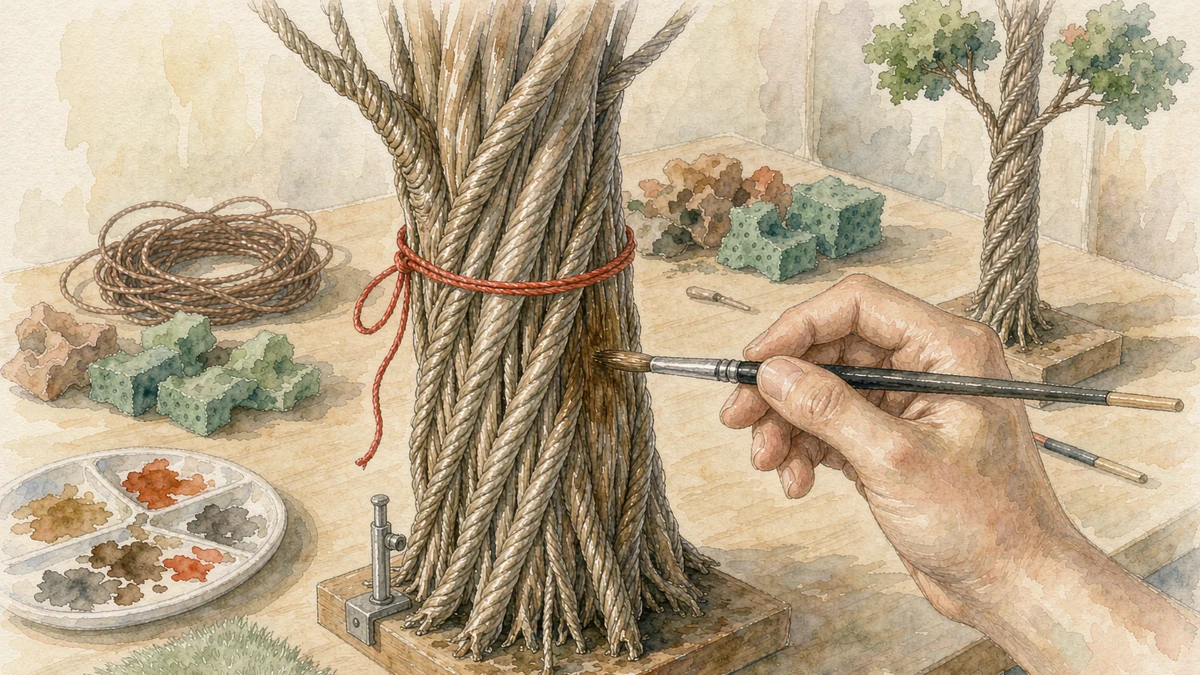
One coat of brown looks like a stick. Our makers build bark up in two or three thin passes: a base tone, a darker wash that settles into the twists of the wire, then a lighter pass along the ridges. Where the wire twists, the wash pools — that is the grain, and it arrives on its own rather than being drawn on. On a large one-off commission at the bigger scales, a maker may work the bark with a brush instead of a spray gun — those orders are rare, but on a single hero tree the extra control is worth the time.
The colour follows the species and the ground it grows on: cool grey for beech, warmer brown for pine, near black in the crevices of a mature oak. This is also where most of the piece-to-piece variation comes from. The same maker will not paint two trunks identically on the same morning, and we do not ask them to — a row of trees should look like they grew there, not like they were ordered together.
A crown is not a blob stuck on a stick. The branch skeleton goes on first, then the foliage in layers: a denser, darker inner mass, then finer and lighter material towards the outside. That layering is what gives you depth when you look into a tree rather than at it.
At 1:48 we can open a crown up enough for you to see through to the trunk. At 1:87 we keep it tighter, because an open crown at that size simply looks thin. Getting that balance wrong is the difference between a tree and a lollipop.
Our foliage is dyed sponge, in several thicknesses and colours. The colour runs through the material rather than sitting on it: cut a piece open and the inside is the same green. That means our makers can cut, thin and trim on the bench without leaving a pale core — and it means you can trim a tree to fit your scene after it arrives, with nothing to touch up.
We do not spray-paint foliage. It looks right on the day and wrong the first time something brushes against it. The finer sponge grades do double duty as grass and ground cover, and our foliage powder is the same material our makers use for scrub and low planting when you are finishing a base yourself.
Every tree passes three inspection points before it is boxed.
The first is after the trunk is sprayed. Bark, taper and colour are looked at together and away from the bench lamp, which flatters everything — a trunk that looks right under warm light can drift once it is on a layout.
The second is after the canopy is assembled. This is where silhouette and proportion are checked against the reference for that species. A tree that is the right height with the wrong crown shape goes back to be rebuilt, because no amount of paint will fix it later.
The third is at packing. The tree is stood up, turned once, and wrapped. If it sheds, if it wobbles on its base, or if a branch has worked loose, it goes back to the bench instead of into the carton. Each tree is wrapped individually in foam — we have shipped more than 100,000 pieces that way, and our breakage rate sits below half a per cent.
The honest answer is more per piece and more time. Hand labour is hand labour, and the twisted-wire trunks in particular cannot be rushed.
Production runs 15 working days from the day you approve the sample, and the minimum order is 50 pieces — you can mix shapes and species within that. Variation between pieces is part of what you are buying, not a defect we are hiding. If you need 500 trees that are genuinely identical for a hotel lobby, we will say so up front and quote the die-cast option instead, because that is the better tool for that job.
Trees leave our workshop clean, in neutral tones, with a matte sealer over the paint. There are two reasons for that.
Weathering is a decision about one specific scene: how much dust it carries, how warm the light is, whether the tree is meant to look windswept or sheltered. We would be guessing. The second reason is more practical — pre-weathered stock cannot be matched six months later, when you come back for another fifty and find the new batch was finished by different hands on a different week.
Acrylic, enamel and oil all sit fine on the matte sealer, so the finish is yours to decide: dry-brush the trunk, knock the green back with a grey wash, work dust into the base. We would rather hand you a clean tree and let you make it belong.
Our sample pack is six representative tree shapes, each made twice — once with a hand-twisted wire trunk and once with die-cast plastic. Twelve trees, so you can compare the same shape in both materials, next to your own buildings and under your own lighting.
The pack is free. You cover shipping: $9.9 standard, 7 to 12 working days and tracked, or $39.9 express by DHL, UPS or FedEx, 3 to 5 working days. If you are still deciding between scales, our HO gauge and O gauge tree ranges show what the same species looks like at each.
Order your free sample pack, and if you already know what you need, send us the scale, the species and the quantity. We will tell you which trunk material we would use and why.