
Beautiful Model Trees For Your Miniature
Choose model trees in the right order: fix the scale, convert height, set canopy spread, read trunk diameter as age, then match colour to the scene.
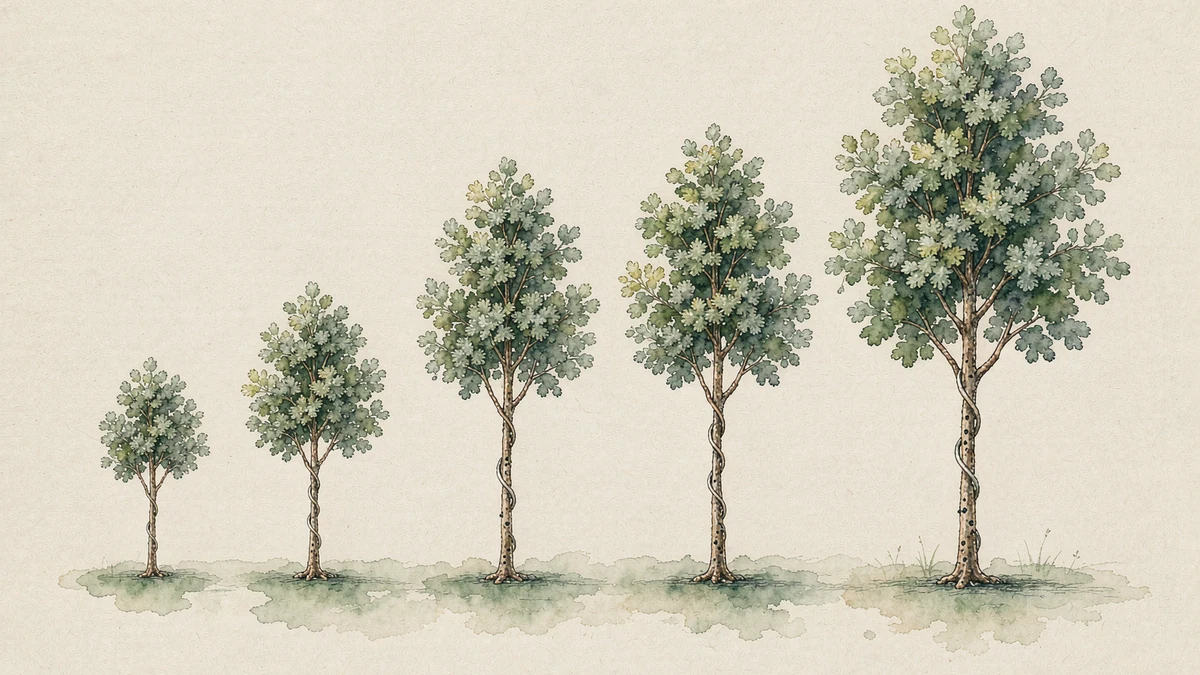
Most tree orders that go wrong go wrong before anyone mentions a species. Someone sees a tree they like, orders sixty, and finds on arrival that it is either a head too tall for the buildings or too short to be worth planting. Not a failure of taste — a failure of sequence. The height got chosen before the scale, and the colour before the scene.
A tree that is right for a railway cutting is wrong for an architectural model and wrong again for a museum diorama, and not for reasons of taste. Below is the order we work through with clients. We have been building model trees in the same Shenzhen workshop since 2003, and this is the sequence that stops a fifty-piece order arriving as fifty surprises.
Scale is set by the rest of your model, so there is nothing to choose. What you can do is stop guessing and convert: real height in metres, times 100, divided by the denominator.
The commonest error is buying by eye from a photograph with nothing in shot for scale. Every catalogue does it, including ours. Put a ruler in the frame before you decide.
Never pick a height in the abstract. Pick the real tree, then convert. Four anchors we use constantly:
Then the check that catches most mistakes: hold the tree beside your tallest building. A two-storey house is roughly six to seven metres, so a tree the same height as your house is a garden ornamental, not the woodland edge you had in mind. Five seconds, and it saves a fifty-piece order.
Spread is specified less often than height and it changes the scene more. A broadleaf grown in the open spreads to somewhere between half and three quarters of its height; the same species packed into a dense stand may only reach a third. Conifers are different again — narrow, and widest low down.
So an 18 cm open-grown tree wants a canopy around 11 to 13 cm across. Give it 6 cm and it is wearing the wrong wig.
This matters commercially too. A square metre of HO baseboard represents roughly 7,500 square metres of real ground, the better part of a hectare. A 12 cm crown covers about 113 square centimetres, so woodland at 12 cm centres wants around seventy trees per square metre. People order twenty and wonder why their wood looks like a park.
If you want a tree to look old, thicken the trunk rather than raising the height. Height says what species it is; girth says how long it has been standing there, and girth is what reads from across a room.
Foresters measure at breast height, 1.3 metres up — 15 mm off the ground at HO and 8 mm at N. Very little trunk to work with, so diameter has to be deliberate. Rough guide: a 10 cm tree on a 1 mm trunk reads as planted within the decade; the same 10 cm on 4 mm reads as a century old. Add a visible taper and a slight root flare at the base — that flare matters most on architectural work, where the base sits at eye level.
Green is not one colour and the gap is not subtle. There is a yellow-green family and a blue-green family, and which one your layout needs is set by everything around the tree. Warm ballast under blue-green foliage reads as plastic however well the tree is built; cool concrete does the same to a yellow-green.
Plant one tree and photograph it in the light you actually view it in. Screens lie, and so does a supplier’s studio. A perfectly uniform green is itself a tell — two or three greens within one species beats a match across the batch.
Because we ship clean rather than pre-weathered, you can correct a whole run after seeing it in position. A light acrylic dry-brush or thin oil wash over the matte sealer pulls fifty trees into line in an afternoon, using your ballast as the reference.
Ten trees at 9, 11, 13, 15 and 17 cm read as woodland. Twenty all at 13 cm read as a plantation. Given the choice between fifty in one height and thirty in five, take the thirty.
Distribution matters too: in a natural group most trees cluster mid-range with a few outliers, not an even staircase. At small scales silhouette variety does more work than species variety — nobody at 1:160 can tell an ash from a sycamore, but everybody can see that every tree is the same shape. And put one bare trunk into every twenty.
Every tree we build sits on one of two trunk types, and this is a real decision rather than a formality.
Hand-twisted wire armature. Our makers scale the species’ proportions and wind the trunk by hand. Nothing is moulded, so no two are identical — lean, taper and small irregularities differ every time. That is what makes a tree look grown rather than manufactured, and it is where the bench time goes.
Die-cast plastic. Designed, scaled and cast, so every tree in the batch is the same. Cheaper per piece, and in the right place the correct choice. What it gives up is variation, and up close the eye counts.
The rule we give clients: if individual trees will be looked at — the front of a layout, a showpiece architectural model, a museum case — go with wire. If you need two hundred screening trees along a back edge nobody gets near, go die-cast and spend the saving on height variety. Both take the same dyed sponge foliage, so mixing them in one order is normal.
Minimum order is 50 pieces, mixed freely — species, trunk material and height in one run, so a single order can cover street trees, screening and one showpiece. Production is 15 working days from sample approval, not from payment, which matters when you are planning backwards from an exhibition date. Every tree is foam-wrapped individually. We have shipped more than 100,000 pieces and breakage sits below 0.5 percent.
Every judgement above — spread, trunk diameter, whether the green sits with your ballast — can only be made with a real tree in your hand on your own baseboard.
Our sample pack is twelve trees: six representative shapes, each in both trunk materials, so you can compare hand-twisted wire against die-cast plastic on the same species under your own lighting. Free; you cover shipping — $9.9 tracked standard in 7 to 12 working days, or $39.9 by DHL, UPS or FedEx in 3 to 5. Tell us your scale and the three shapes you most want to see.
We are the factory, not a trading company — the same Shenzhen floor since 2003, no middleman margin between your invoice and the bench. Specifications for each scale are on the HO, N, O and OO pages.
Comments are closed.


Hi, this is a comment.
To get started with moderating, editing, and deleting comments, please visit the Comments screen in the dashboard.
Commenter avatars come from Gravatar.